Chapter : Light Reflection and Refraction
MCQs
Q. A 5 cm long rod is placed vertically in front of a concave mirror. If its 5 cm long image is formed at 20 cm in front of the mirror, the focal length of the mirror is :
(A) − 20 cm
(B) − 10 cm
(C) − 5 cm
(D) 20 cm [CBSE 2025]
Q. A convex lens of focal length 15 cm is forming a real image. If the size of image is same as the size of object, then position of object and position of image will be, respectively:(A) –15 cm and –15 cm from lens
(B) –15 cm and +15 cm from lens
(C) –30 cm and +30 cm from lens
(D) –30 cm and –30 cm from lens [CBSE 2026]
Assertion and Reason based questions.
Q. Assertion (A): When rays of white light pass through a prism, on emerging they give spectrum of seven colours.
Reason (R): It is due to the scattering of light that red light bends minimum and violet light bends the maximum. [CBSE 2026]
2 Marks Questions (Very Short Answer)
Q. The given figure shows image formation by a lens. Analyse the figure and answer the following questions:
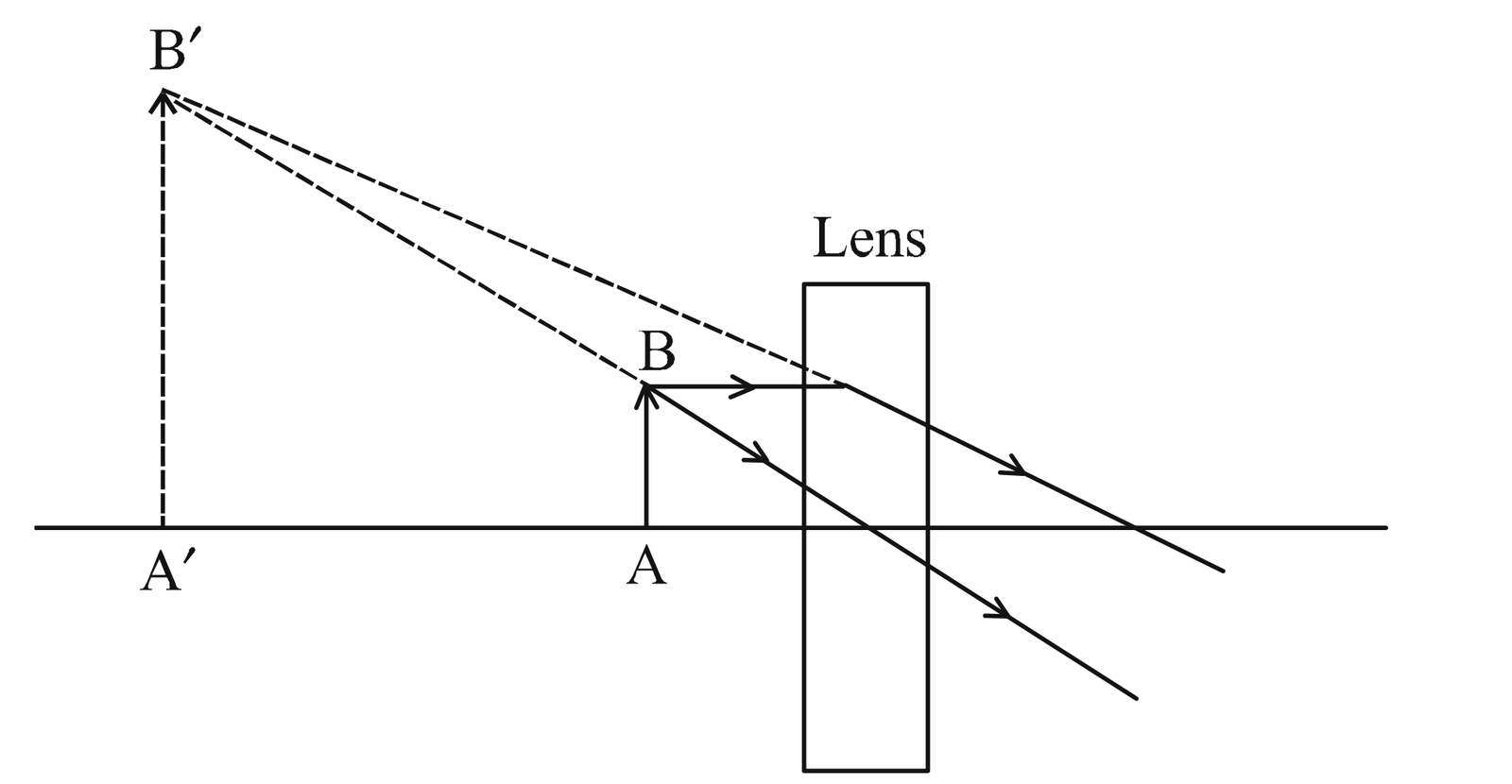
(a) What is the type of lens used for image formation in the given ray diagram?
(b) If the real image is formed at a distance of 30 cm from the lens and the size of image is twice the size of the object, then where was the object placed? [CBSE 2026]
Q. A mirror always forms a virtual, erect and diminished image. Identify the mirror and draw a labelled ray diagram for image formation by this mirror. [CBSE 2026]
Q. Draw the ray diagram for the image formation by a lens which shows a magnification of +2. [CBSE 2026]
3 Marks Questions ( Short Answer)
4 Marks Questions
Q. Read the following passage and answer the questions given below:
Lenses can form different types of images depending upon their focal length and position of object. A convex lens can create real, inverted or virtual, erect images, while a concave lens forms only virtual and diminished images. The focal length determines the power of lens. Convex lenses have positive focal length while concave lenses have negative focal length by convention. When lenses are placed together, their combined power is determined by the sum of their individual powers. Ray diagrams help to visualize how light converges or diverges through lens to form an image.
(a) A convex lens of focal length 20 cm is used to form an image. If an object is placed at 40 cm from the lens, what will be the position and nature of image? (1)
(b) Illustrate the formation of image with the help of ray diagram, when the object is placed between the optical centre and principal focus of concave lens. (1)
(c) (i) A lens combination consists of a convex lens of focal length 30 cm and a concave lens of focal length 15 cm placed together. Find the equivalent focal length and power of this lens combination.(2marks)
OR
(c) (ii) Two lenses are placed in contact. One is a concave lens with focal length 2 m and the other is a convex lens with focal length 1.5 m. What type of lens will the combination behave as (convex or concave)? Give reason.(2marks) [CBSE 2026]
Chapter: Human Eye and Colourful World
MCQs
Q. When you look at an object very close to your eyes, the:
(A) Ciliary muscles of your eye contract and the eye lens becomes thick.
(B) Ciliary muscles of your eye get relaxed and the eye lens becomes thick.
(C) Ciliary muscles of your eye contract and the eye lens becomes thin.
(D) Ciliary muscles of your eye get relaxed and the eye lens becomes thin. [CBSE 2026]
Assertion and Reason based questions.
Q. Assertion (A): When rays of white light pass through a prism, on emerging they give spectrum of seven colours.
Reason (R): It is due to the scattering of light that red light bends minimum and violet light bends the maximum. [CBSE 2026]
2 Marks Questions (Very Short Answer)
3 Marks Questions ( Short Answer)
Q. (a) What is hypermetropia?
(b) Write any one cause of hypermetropia.
(c) With the help of a suitable ray diagram, explain how hypermetropia is corrected? [CBSE 2026]
Q. A person is unable to read a book placed closer than 1 meter from his eyes. Identify the defect of vision in his eyes. Draw the ray diagrams to show the defect of vision and its correction. [CBSE 2026]
Q. (a) What is Tyndall effect?
(b) What happens when sunlight is scattered from the particles of very large size?
(c) ‘Danger’ signals are always red in colour. Why? [CBSE 2026]
4 Marks Questions
Chapter: Electricity
MCQs
2 Marks Questions (Very Short Answer)
Q. The resistance of a wire of 0.01 cm radius and 1.0 cm length is 7 Ω. Calculate its resistivity. [CBSE 2026]
Q. An electric heater is rated 220 V; 11A. Calculate the power consumed is the heater is operated at 220V. [CBSE 2026]
3 Marks Questions ( Short Answer)
4 Marks Questions
5 marks question
Q. (i) Due to change in length and area of cross-section of a conductor, resistance of conductor changes while resistivity does not change. Why?
(ii) Conductors of electric toasters and electric iron are made of an alloy rather than a pure metal. Why?
(iii) Define the S.I. unit of electric current. [CBSE 2026]
Q. (i) How many bulbs of resistance 8 Ω each should be connected in parallel combination to draw a current of 2 A from a battery of 4 V?
(ii) Name the device used for measuring electric current. How is it connected in a circuit?(iii) State Joule’s law of heating. [CBSE 2026]
Q. (i) Consider the following electric circuit:
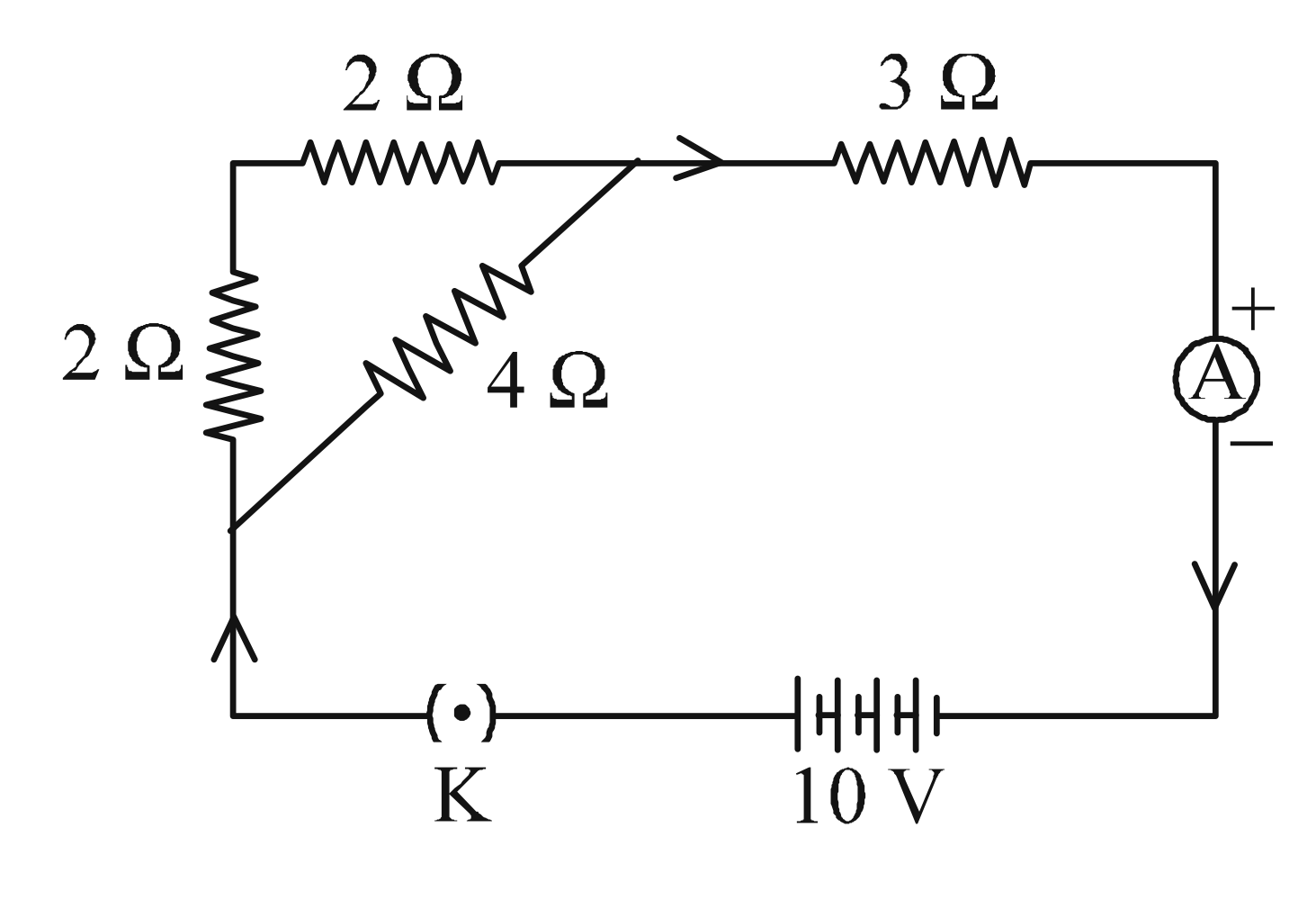
Calculate the values of the following:
(I) Total resistance of the circuit.
(II) The total electric current drawn from the source.
(III) Potential difference across 3 Ω resistor.
OR
(ii) Two bulbs, rated as 100 W; 220 V and 60 W; 220 V are connected in parallel to an electric main supply of 220 V. Calculate the electric current drawn from the mains. [CBSE 2026]
Q. (i) State Ohm’s law and draw V-I graph for a conductor which follows Ohm’s law. Show that the slope of V-I graph gives resistance of conductor.
(ii) Derive an expression for the equivalent resistance of a series combination of three resistors having resistances R₁, R₂ and R₃. [CBSE 2026]
Q. Study the given electric circuit in which 2 A electric current is flowing between points X and Y.
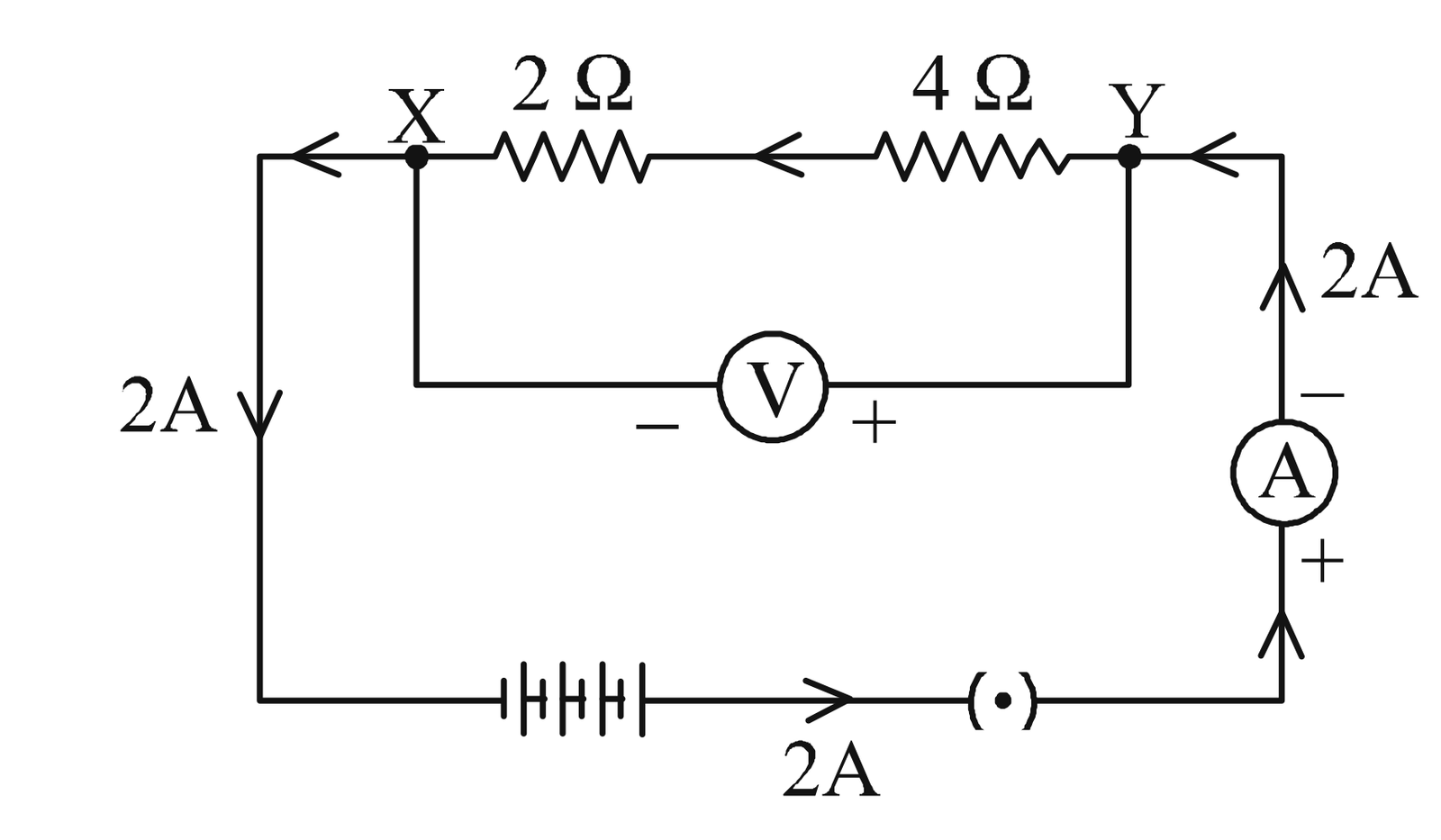
(i) Using the battery, key, voltmeter and ammeter in this given electric circuit, redraw a circuit diagram in which 2 Ω and 4 Ω resistors are connected between X and Y in parallel combination.
(ii) Circuit drawn by you, in which resistors are connected in parallel combination, calculate the electric current flowing through 4 Ω resistor. [CBSE 2026]
Q. (i) Two lamps ‘A’ and ‘B’ of rating 50 W; 220 V and 100 W; 220 V are connected in series combination. Find out the ratio of the resistances (Rₐ : Rᵦ) of the lamps.
(ii) Derive the expression for the equivalent resistance of three resistors R₁, R₂ and R₃ connected in parallel combination. [CBSE 2026]
5 Marks Questions
Chapter : Magnetic Effect of Electric Current
MCQs
2 Marks Questions (Very Short Answer)
3 Marks Questions ( Short Answer)
Q. (a) Describe an activity to show that a current carrying conductor, placed in an external magnetic field experiences a force.
(b) Imagine that you are sitting in a chamber with your back to one wall. An electron beam, moving horizontally towards the front wall from the back wall, is deflected by a strong magnetic field to your right side. Find the direction of the magnetic field. [CBSE 2026]
Q. The pattern of magnetic field due to a current carrying wire depends upon the shape made by that wire. Justify. [CBSE 2026]
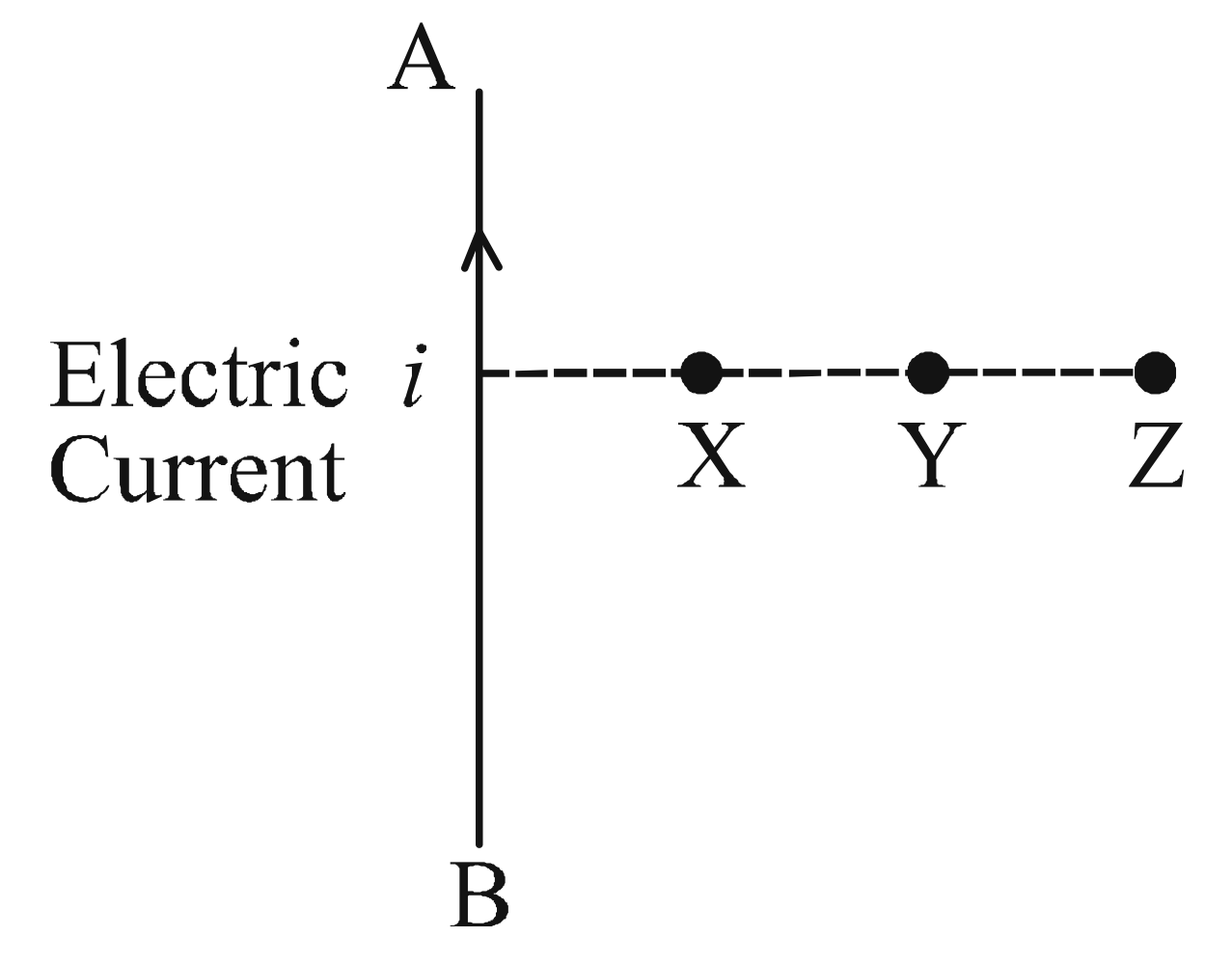
Q. A current carrying straight wire AB is shown in the given diagram. Out of X, Y and Z on which point will the strength of magnetic field be maximum and why ? [CBSE 2026]